David Tomb’s Grand Birds
Hungry Hyaena
Hungry Hyaena
Originally published by Hungry Hyaena.
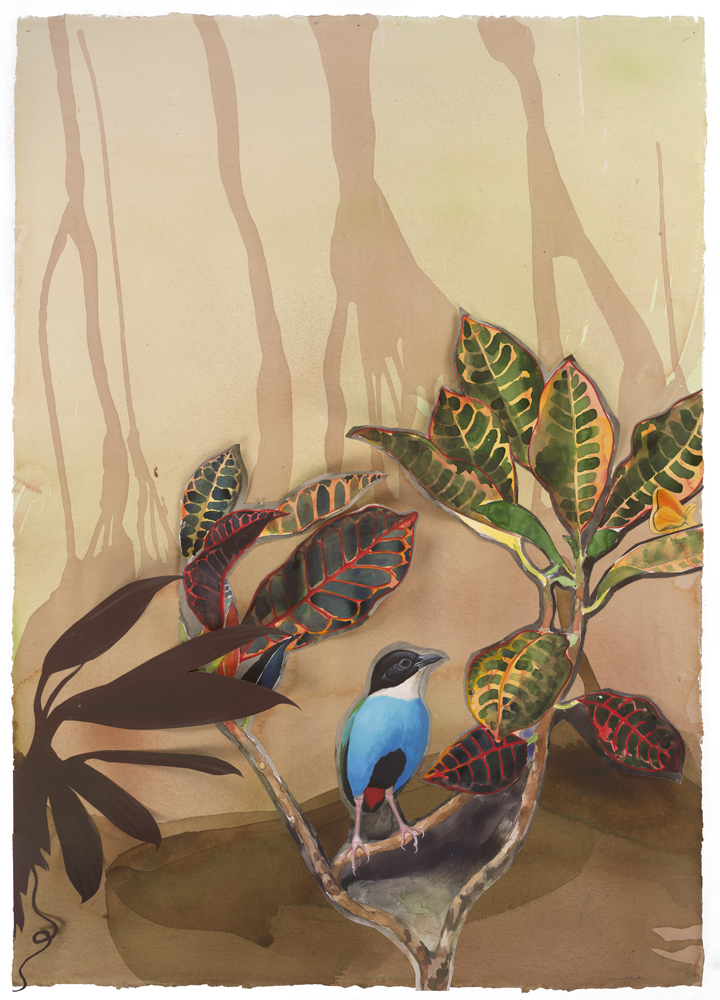
“Grand Birds of the Philippines,” David Tomb’s current solo show at Electric Works, is deserving of a thoughtful review. Disappointingly, my writing time is limited this month and I can provide only a few observations.

Birds have been the principal protagonists of David Tomb’s colorful watercolor and gouache paintings for the last six or seven years, but “Grand Birds of the Philippines” sees the artist pushing the construction of his works in exciting ways. Tomb builds the new pictures by pinning and pasting select fragments of various paintings and drawings onto larger paper grounds or directly onto the gallery walls. Viewers will spot numerous pin holes in the exhibited assemblages, evidence of earlier permutations; an orchid was moved to a different branch, perhaps, or a swift’s dark silouhette adjusted so that it chases another gnat. Here and there, a vine or butterfly wing is left unfixed, protruding from the picture’s surface and lending a sculptural effect to the work.
Tomb’s approach, which calls to mind Judy Pfaff’s “sculptural painting,” is a surprisingly effective technique for a wildlife artist (or, more accurately in the case of Tomb, a contemporary artist working at the fringe of that genre). The assemblages have a playful and provisional feel to them that is satisfyingly fresh, but the technique also heightens the sense of space and, in some of the works on display (most notably, the show’s pièce de résistance, “Great Philippine Eagles”) supplies a verisimilitude normally lacking in natural history art and illustration. As in the field, our eyes dart around the impressive image, and the 3-dimensional elements cause the lenses of our predatory eyes to subtly flex and relax, bringing different subjects or areas into focus. Tomb smartly exaggerates this effect by painting soft watercolor wash backgrounds that fall suddenly away where they come up against a pinned down hard edge.

Of the smaller works in “Grand Birds,” “Azure-breasted Pitta” and “Mindanao Wattled Broadbill and Swift” are the most compositionally engaging and successful, but this writer, a bird and snake nut, also reserves a special place for Tomb's exuberant “Mindanao Hornbill, Wagler’s Pit-Viper, and Collared Kingfisher.”
If David Tomb’s work appeals to you but, like me, you’re operating on a lean budget, you can support the artist’s conservation non-profit, Jeepney Projects, by purchasing benefit prints and, in a few weeks, note cards on the Jeepney website store. 100% of the print and card sales proceeds support bird conservation efforts in Mexico and the Philippines.
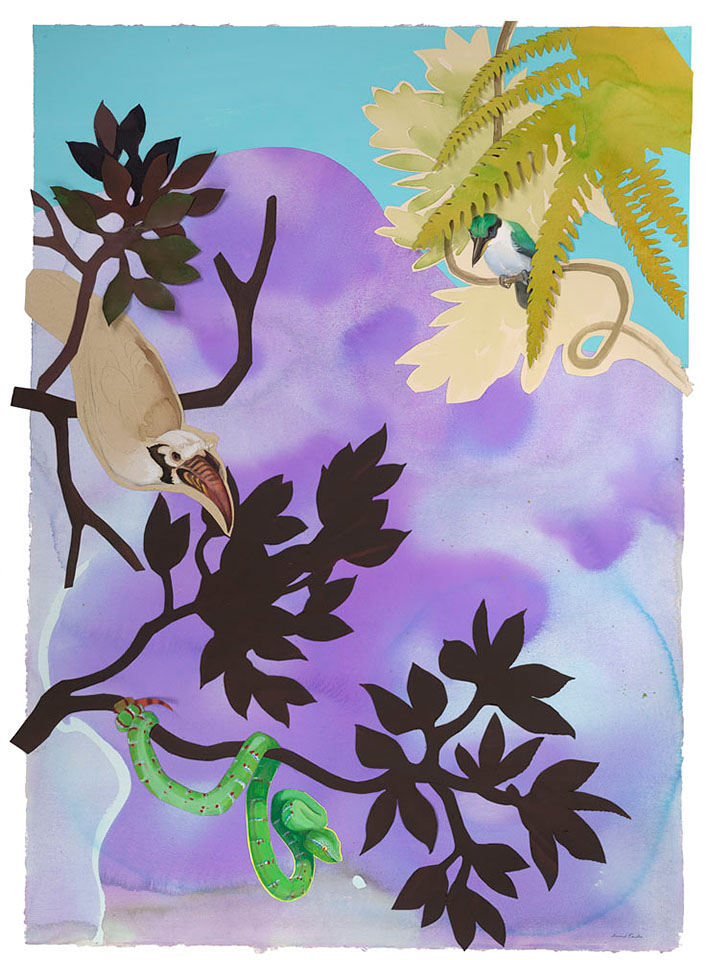
Image credits: copyright, David Tomb, 2012; courtesy David Tomb and Electric Works