

by George Oxford Miller
(Originally published in Living Bird Spring 2012, pp 28–35. Republished with permission of the author; see publisher’s site for original version)
A captive-breeding program offers new hope for the Philippine Eagle
Eleven hours of waiting, watching. Yesterday we sat for six hours on a bamboo bench in an intermittent drizzle and scanned a distant slope hoping for a glimpse of the largest, most endangered raptor on the planet, the Philippine Eagle, national bird of the Philippines. Today we’ve been scoping the mountain ridges intently for another five hours, this time in the blazing sun. Soaring Oriental Honey-buzzards and Phil- ippine Serpent Eagles temporarily get our adrenaline pumping, but they’re only diversions.
Finally, Pete, a fellow bird watcher, yells, “A big, white bird landed in the tree by the cliff.” We had studied the distant slopes for so long we had the landmarks memorized. I focus the scope to 50x and see the object of our quest perched regally in the distant tree about a mile away.
The eagle flies to another tree, and we spot an immature. The adult soon departs as the juvenile bends over and rips pieces from the prey its parent brought and eagerly gulps them down. After its meal, the juvenile flies a short distance to another tree, sits a while, then flies back as though practicing its flying. Transfixed, we spend the next two hours gazing at the bird.
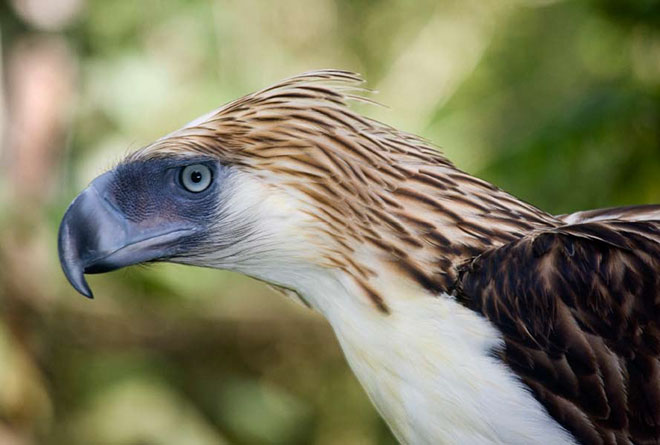
Even in captivity, a Philippine Eagle is a stunning sight to behold with its shaggy crest and huge size.
After flying from Manila to Cagayan de Oro on the island of Mindanao, we drove for four hours on a narrow, winding mountain road through remote villages with thatched-roof, bamboo huts, then transferred ourselves and our gear to the back of a four-wheel-drive flatbed truck. Finally, at the end of the muddy road, villagers lashed our luggage onto the backs of some scrawny little horses. We pulled on rubber boots and started a one-hour ascent up a slippery trail, sometimes sloshing through ankle-deep slush, to reach our rustic bird-watching “ecolodge”—a decaying barn with a dormitory loft that had no beds or flush toilets, and only a plastic bucket for bathing.
At that point, we still had another two-hour, rubber-boot hike to reach the eagle-viewing site—a long bench made from split bamboo in a hacked-away clearing in an overgrown potato field that nature has reclaimed. But the view is spectacular, a deep gorge with a hidden river encompassing a long ridge and twin rounded mountains—perfect habitat for the soaring kings of the rainforest.
Nicky Icarangal, our guide with Birding Adventure Philippines, studies the eagle in the scope. “See the white spots on the wings?” he says. “It’s an immature. Philippine Eagles mate for life and take two years to raise a chick. The young take five to seven years to sexually mature. They live about 20 years in the wild. This pair nests up and down the river gorge, so this is one of the most reliable places to see the eagles in the wild. Plus we get a chance to see the mountain endemics that live at this elevation.”
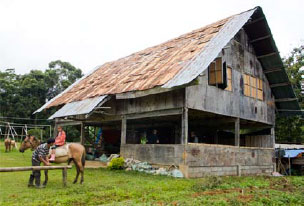
Mount Kitenglad birding ecolodge was built in 1993 with a grant from Del Monte.
During our hours of idle watching, flocks of small birds dash past to break the monotony. Sparrow-sized Chestnut Munias, a popular cage bird in the pet trade and former national bird of the Philippines, zip into the tall grass. Apo Mynas, black with a brilliant yellow patch of bare skin around their eyes and a fuzzy crest, perch and watch us watch them. The smaller birds are exciting, yet not the reason we flew 7,000 miles and tramped four miles up a muddy trail. But with the first sight of the magnificent eagle, we forget the hardships.
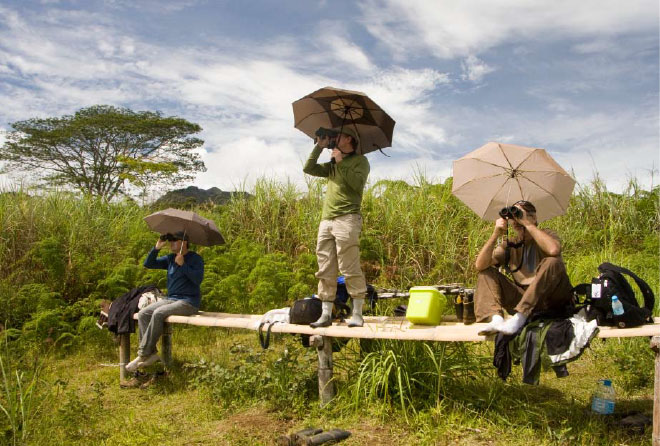
Birders scan the skies at the Mount Kitenglad eagle viewpoint.
Besides seeing the endangered raptor, we came to plan a fundraiser for the Philippine Eagle Foundation. Located in Davao, the foundation is ground zero for efforts to breed the eagles in captivity and release them to the wild, and also to educate mountain villagers about the bird. A study published in the journal Ibis in 2003 reported that enough habitat exists to support 82 to 239 nesting territories—depending on how the remaining forest on Mindanao is analyzed—and concluded that “the Philippine Eagle probably remains the most important [avian] single-species con- servation issue on the planet today.”
David Tomb, a wildlife artist who organized our group of four, previously created life-sized paintings of the Mexican Tufted Jay to raise funds for a wildlife preserve in the oak canyons near Mazatlan (see “A Canyon of Their Own,” Living Bird, Summer, 2009). For the current project, he is planning an exhibit at his San Francisco gallery featuring the Philippine Eagle and other birds of Mindanao to benefit the foundation and its education projects. So seeing the eagle fires our enthusiasm for better reasons than achieving another check on our life lists.
After a few quick first views, we take turns at the scope for longer studies of the eagle. Then David shouts, “Look! A monkey! Climbing the limb above the eagle!” Again we rush to the scope. The 3-foot-tall raptor with a 7-foot wingspan was formerly known by the more sensational name of Philippine Monkey-eating Eagle, but the juvenile pays no attention to the foolhardy macaque perched above it in the canopy.
As every birder knows, not every adventure has a checklist payoff. With hundreds of square miles surrounding Mount Kitanglad, our chance of spotting the eagle, much less a nest, was far from assured. A pair of Philippine Eagles requires 50 square miles of hunting territory to be able to catch enough flying lemurs, squirrels, snakes, civets, hornbills, and long-tailed macaques to nourish a nestling.
Though the area is designated a natural park, most of the land surrounding the mountain habitat, with the exception of deep ravines, has been cleared by slash-and-burn farming. Only the forest on the steep mountain slopes and rugged ridges remains intact. The trail from the lodge passes one field after another—some new, some exhausted and overgrown with thorny lantana, bushy sunflowers, and a bramble of invasive weedy species. In many places, the shallow layer of soil has washed away, exposing barren mounds of slippery, infertile red clay.
Farmers plow with water buffalos and pack out 200-pound sacks of cabbage, corn, peppers, taro, potatoes, and tomatoes using the same workhorses that toted our luggage on the same muddy foot trails we labored up. Farmers sell their cabbage to dealers in the village for 6 pesos per kilogram ($.06 per pound). Dealers get 15 pesos per kilogram wholesale, and the stores in Manila charge 45 pesos per kilogram ($.47 per pound) retail. Field workers receive about 150 to 200 pesos a day ($3.35–$4.50). The ever-expanding farmland pushes wildlife into the diminishing forest and eventually to extinction.
Along the trail, we see a Sunbird and tramp across the charred, fractured remains of a recently burned section to the edge of the uncut, verdant forest. Foot-tall fiddleheads sprout from rhizomes through the charred soil and cover the denuded plot. In a few weeks waist-high ferns will blanket the hillside. Potato seedlings sprout from the broad rows of recently plowed and planted adjacent fields.
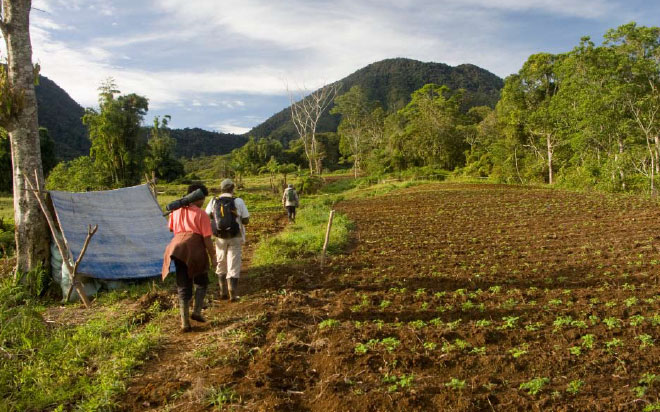
Visiting bird watchers hiked past one slash-and-burn farm after another on the way to the Philippine Eagle viewing area.
The variety of bird calls announces a mixed flock foraging through the canopy. Busy little Mountain White-eyes, which we see in abundance, skitter through the leaves, joined by the flamboyant Coppersmith Barbet, Grey-hooded Sunbird, Fire-breasted Flowerpecker, and Rufus-headed Tailorbird. Mixed flocks give us the exciting opportunity to see a flush of rainforest birds all at once, especially when they congregate around a tree in flower or fruit.
“This forest will be cut before next year,” Nicky tells us. “Every season the squatters slash and burn deeper into the forest. This is a natural park, but that doesn’t stop villagers and even people from other islands from moving in and farming.”
Deforestation and illegal hunting pose the greatest threat to the Philippine Eagle and other forest birds. The Philippines topped 100 million inhabitants in 2010. Estimates of how much old-growth forest remains vary greatly, but a best guess is somewhere near 7 percent. From what we see during our two-week visit on Mindanao, primary forest is doomed in the short term and secondary forest in the near future. With an exploding population and a government not interested in environmental controls or conservation, the forest will of necessity be converted into farmland or banana and palm-oil plantations.
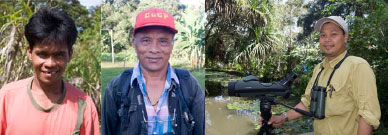
Danny Docenos (left) is one of the bird guides at Mount Kitenglad ecolodge. Bird guide Carlito Gayramara (center) and his family operate the ecolodge. Nicky Icarangal (right) leads birding tours for Birding Adventure Philippines.
The near-perpendicular ridges and slopes of Mount Kitanglad resist farming and harbor the breeding pair of Philippine Eagles we see. Other populations live in remote areas, most too rugged to inventory, on the islands of Luzon, Samar, and Leyte. The Philippine Eagle Foundation estimates that enough habitat exists for at most 200 pairs in the mountainous regions of Mindanao and another 200 pairs in the rest of the archipelago.
As the finale of our trip, we visit the Philippine Eagle Foundation in Davao, largest city on Mindanao. As part of the yearlong research for his art exhibit, David has conferred with the foundation and arranged for us to meet the staff and tour the grounds. Executive director Dennis Salvador has been with the foundation since it began. We sit in his office and dodge Glossy Swiftlets that dart though the open window to get to their nests in the hall.
We cross the bridge into a wooded compound and see more birds foraging in the trees than kept in cages. A Blue-throated Bee-eater and Hooded Pitta temporarily distract us from a tethered Brahminy Kite sitting on a limb a few feet above the path. It poses for us unperturbed.
Three large flight cages built into the hillside hold breeding pairs of Philippine Eagles. Other cages hold fishing eagles, serpent eagles, hawk eagles, and some native mammals. We meet Anna Mae Sumaya, director of breeding biology, in front of a Philippine Eagle perched on a stump just off the path.
“This is one of our captive-bred eagles,” she says. “He’s nine years old. The first breeding in captivity occurred in 1992. We use him for artificial insemination and education.”
The foundation harbors 35 Philippine Eagles, including three males and two females used for artificial insemination, three natural pairs, and six pairs in various stages of bonding. The oldest is 43 years old.
“Our goal is to produce two eaglets per year,” Anna Mae says. “We had four chicks in 2001, but our breeding pairs are getting old and don’t produce as much. The challenge is to add new breeding pairs. We hope some of our new pairs will bond soon and breed.”
Raising and releasing captive-bred eagles into the field presents a host of problems. Of the seven captive-bred and rehabilitated eagles released since 2004, only two have been successful. Anna Mae hopes new techniques and training will improve the odds.
“We have to be sure the chicks don’t imprint on humans,” she says. “We feed them with puppets and use mirrors so they never see us. As they near release age, we put them through aversion training to learn to avoid electric wires. A released eagle was electrocuted in 2004. Another had to be recaptured because it stayed around a village and preyed on farm animals.”
After two years of tender care and training, the captive-bred eagles are ready for the greatest challenge. “We have a young eagle ready to release next month, but we only have one hacking site, on Mount Kitanglad. We need other sites, but finding habitat is a major problem.”
The release team monitors the eagle and provides food if needed for three months. But food isn’t the newly released eagle’s greatest threat. “Hunting is a major problem,” Anna Mae says.
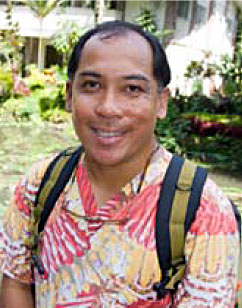
Dr. Bo Puentespina volunteeers as the veterinarian for the Philippine Eagle Foundation.
The morning we arrive at the foundation, avian veterinarian and volunteer Bo Puentespina has just finished operating on an immature eagle with gunshot wounds in its wing and leg. He leads us to a small building and gently opens the door. The eagle lies on a bed of leafy branches in a small cage.
“He was shot two days ago,” he says. “The DENR [Depart-ment of Environment and Natural Resources] brought him to us about midnight. I had to amputate part of his wing but I think he’ll live. He’s only ten months old. It’s a pity to lose a juvenile that could replace the older birds.”
Puentespina has talked to hunters and recently testified in a court case against a man who killed a Philippine Eagle. “I try to understand why someone would shoot them, but I can’t find a good reason,” he says. “Eagles are big amazing birds. It only takes one person to destroy years of work. We’ll use this eagle for edu- cation, to show children what their ‘uncles’ did to this bird.”
Educating the people in the mountain villages about the value of the eagles and their habitat is an integral part of the Philippine Eagle Foundation’s mission. “We must educate communities to save some forest,” Dennis says. “Not just one village but all the villages around a fragment of forest. Our programs try to link conservation to their own lives and change their values.”
The foundation offers 2,000 pesos (about $45) to any villager who finds a nest and another 2,000 pesos for the village. A field team goes to the village and evaluates the grassroots needs with meetings and discussions.
“Sometimes it’s a water system or a school building,” Dennis says. “We provide fertilizer so they won’t have to abandon wornout fields and slash and burn more forest. Our urgent goals are to preserve what’s left of the forest and to reforest corridors to connect the fragments. But to do that we must educate communities that their survival is linked to the survival of the eagle. Saving the forest saves the watershed, prevents flooding, and can bring money through ecotourism.”
Another major concern is avian influenza. “It’s not if but when it reaches the Philippines,” Dennis says. “I wish we could send Philippine Eagles to zoos around the world in case our population is affected. I’ve requested permission from the DENR but they haven’t responded.”
The majestic Philippine Eagle, king of the rainforest, stares at us from its perch as we leave the foundation. Despite a lack of government support and with official policies that encourage mining and clear-cutting for agro-industrial plantations, the Philippine Eagle Foundation pushes forward with a commitment forged in passion and persistence.
While waiting in line to enter the Manila airport on my way home, I pass a large sign on the door that reads: “Warning, Wildlife Resources and Conservation and Protection Act 9147 prohibits collecting, hunting, or possessing wildlife.” How ironic.
George Oxford Miller is a freelance writer and photographer based in Albuquerque, New Mexico. He frequently writes for this magazine.
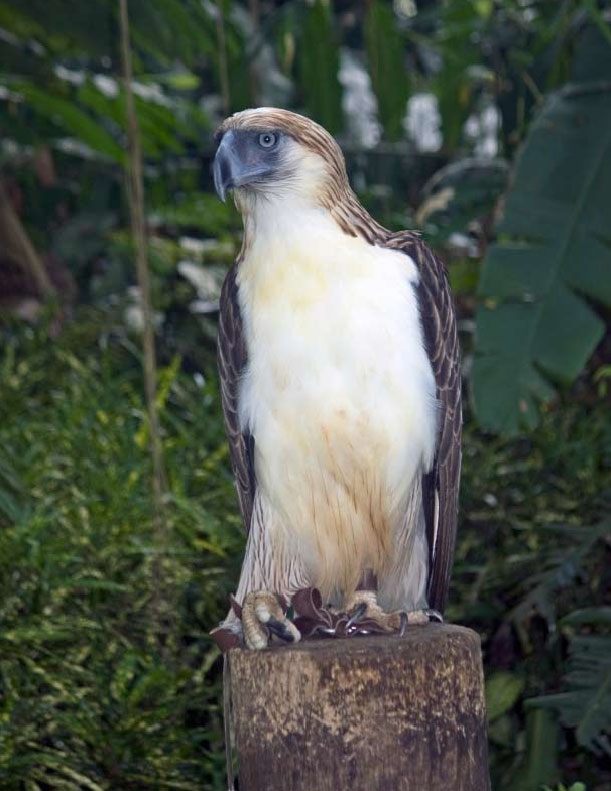
The Philippine Eagle Foundation uses nonreleasable male eagles that can’t be released for artificial insemination and public display.
[Reprinted with permission. Please visit Audubonmagazine.org for the original article.]
By Daisy Yuhas, Audubonmagazine.org
February 15, 2012
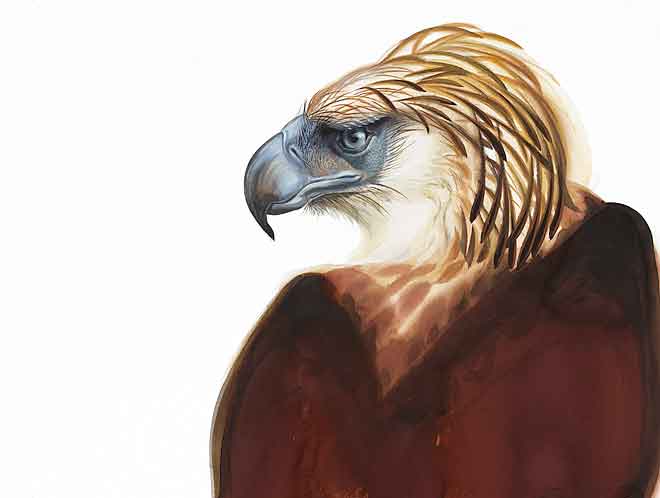
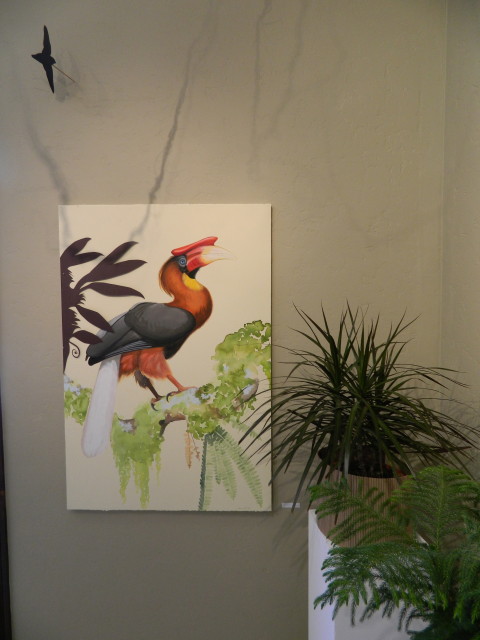
The Greater Philippine Eagle, painted by David Tomb
It was a moment that changed everything. David Tomb had journeyed nearly 7,000 miles to see this bird —the holy grail of birding— and when finally face-to-face he discovered a creature that was majestic, leonine, and incredibly vulnerable.
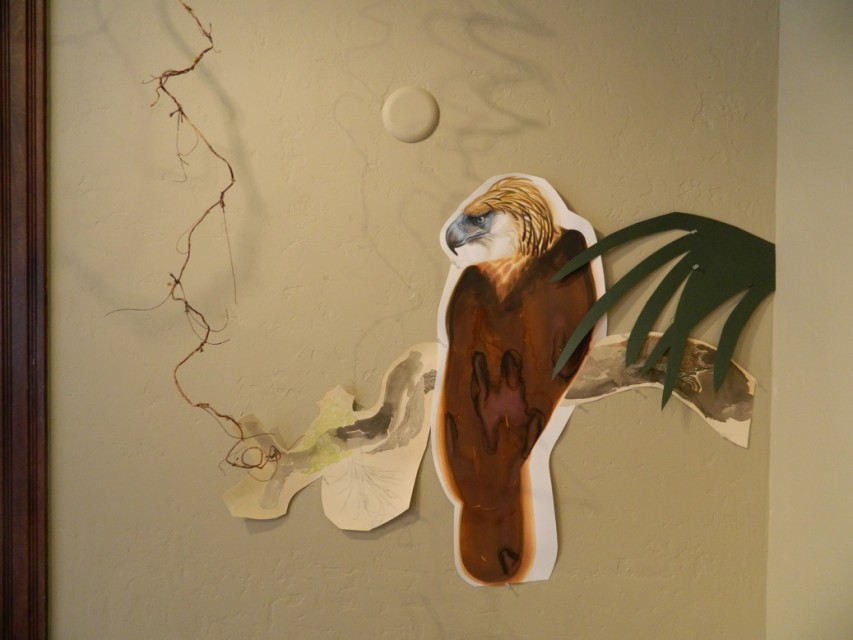
The bird was a great Philippine eagle, a massive raptor with a seven foot wingspan and mane of feathers. An impressive predator, the powerful bird of prey was once called the “Monkey-Eating Eagle,” and today human activity has reduced its numbers to about 200 individuals in the wild.
Tomb, an artist who returned to his first love — birds — after twenty years of human portraiture, travelled to the Philippines in 2011. He and a group of birding buddies found themselves moved in an unprecedented way when they encountered the Philippine eagle not in the wild but in a hospital run by the Philippine Eagle Foundation. There, they watched as the majestic animal, recovering from surgery after suffering gunshot wounds and a wing amputation, awakened from anesthesia.
“We went into the recovery room and there it was: One of the biggest eagles in the world, wrapped in bandages,” Tomb says. “Its eyes were blinking and it just started to chirp… It was this incredibly awesome creature that was so incredibly vulnerable.”
Discussing the experience with his travel companions, Tomb decided he wanted to do more than just witness these amazing animals, he wanted to save them. With friends Peter Barto and Howard Flax, Tomb founded the nonprofit Jeepney Projects Worldwide to use art as a way to raise awareness of high-priority conservation birds, their habitats, and support their survival.
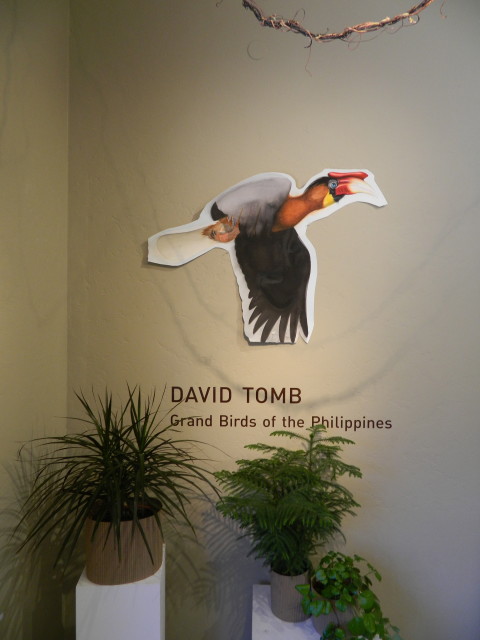
The group takes a creative approach to their mission. Tomb draws viewers into the experience of seeing birds in their habitat with a multi-sensory gallery experience. Live plants hint at the scent of the outdoors. An interactive soundscape, designed by johnnyrandom’s Flip Baber, follows the viewer through the gallery, immersing the viewer in the eagle’s world with calling macaques, blowing breezes, and bird song.
The experience is meant to captivate, raising awareness of a the endangered eagle and importance of saving its habitat. Tomb uses art as an entry point to dicuss the bird’s plight and the work of the center in preserving habitat, rehabilitating birds, and empowering local communities whose poverty puts pressure on the eagle’s habitat. Tomb also sells benefit prints through the website to raise funds for both the Philippine Eagle Foundation and another key bird habitat, El Triunfo Biosphere Reserve in Chiapas, Mexico.
“It’s so gratifying to utilize art work, to make art work of something you love and put it towards something you love,” says Tomb. “And to have it work.”
So far, Tomb notes, responses have grown with every retelling of the eagle’s story. In the year since the project’s creation, Tomb has created several original prints and already sold twenty. Tomb also hopes that as awareness of the Philippine Eagle grows, more people will learn about sustainability and how the demand for Philippine Mahogany has pushed the bird’s numbers down, causing massive deforestation.
Below are two more of Tomb’s paintings, and you can click this link to listen in to a soundscape depicting the eagle’s habitat (hint: you can run it on a separate tab while viewing the paintings here). For those near Berkeley, California, you can see Tomb’s work on display at The Bone Room through February 29, and his work will also be displayed this June at San Francisco’s Electric Works.
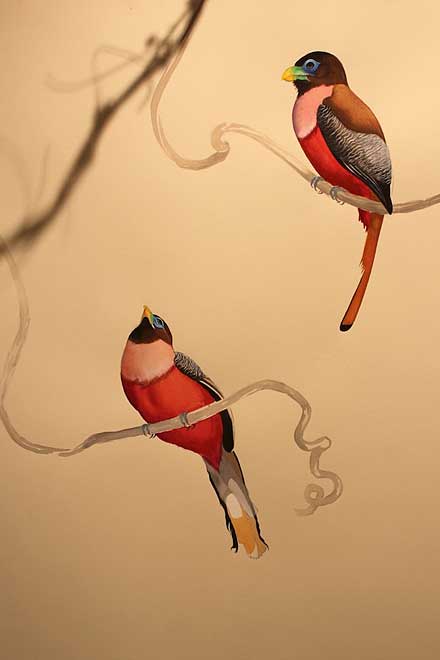
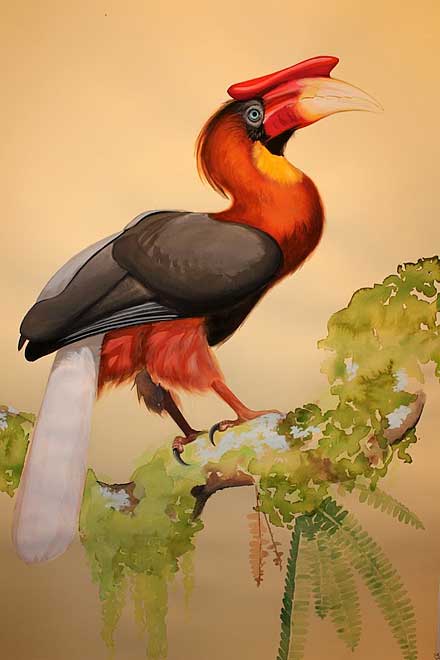
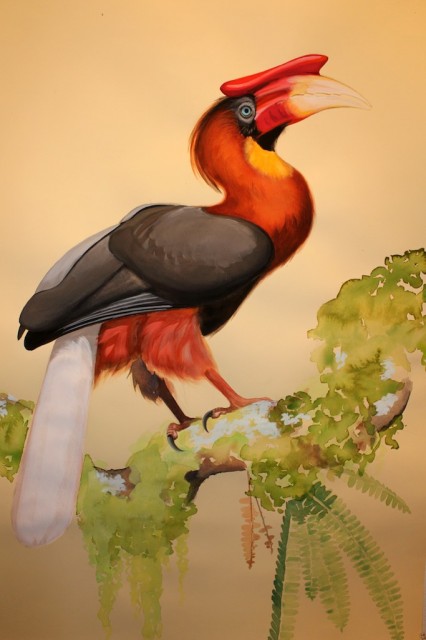
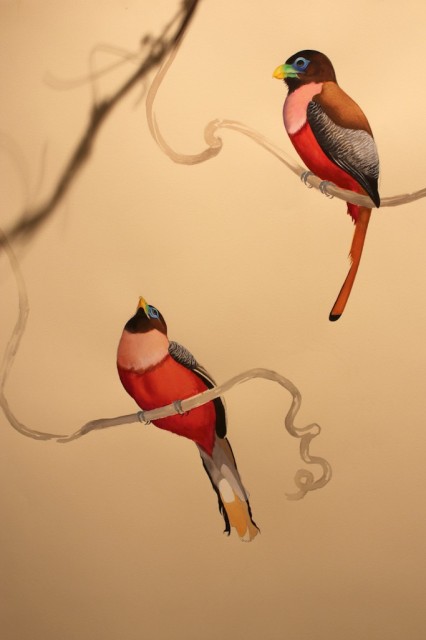
Paintings above and below by David Tomb
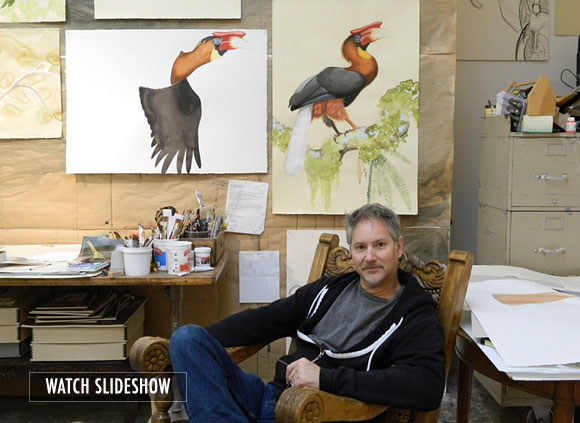
While growing up on an Oakland hillside, artist David Tomb — his last name is pronounced “Tom” as in “Tom Sawyer” — was interested in both art and birds. “I’m not sure which interest came first,” he muses. The home where Tomb grew up was filled with landscape paintings by his grandfather, the California Impressionist Sydney Lemos (1892 – 1944), and he remembers being fixated on the texture of a painted redwood tree in one of them. On the other hand, there were often turkey vultures sunning themselves in an oak tree behind the house, and they were at least equally fascinating.
“I was a bird nerd kid,” says Tomb. Accordingly, he spent many hours with his nose in vintage bird books including the field guides of Roger Tory Peterson (1908 – 1996), and numerous illustrated books by the American ornithologist and artist Luis Agassiz Fuertes (1874 – 1927). Fine art was a kind of parallel fascination, and although 18-year-old Tomb did a few bird drawings at the California Academy of Sciences in San Francisco, art was about something else; at least it started out that way.
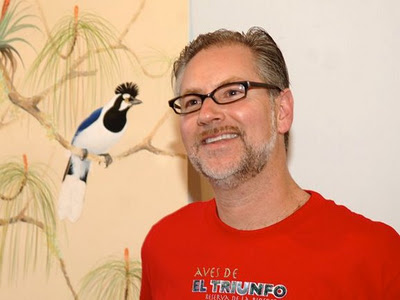
David Tomb
While attending Cal State Long Beach as an undergraduate, Tomb studied drawing with John Lincoln, who in turn was a student of the figurative expressionist Rico Lebrun (1900 – 1964). Not surprisingly, Tomb also used the figure as his main artistic vehicle. After earning a bachelor’s degree in fine arts in 1984, Tomb returned to the Bay Area where his work consisted mostly of portraits, including many of friends who would drop by his studio.
As a portraitist, Tomb demonstrated tremendous persistence, developing a practice in which drawing played a key role. “Tomb uses his subjects’ appearance to get his hand going, not as inroads to their character,” is how critic Kenneth Baker put it. In one memorable sequence executed between 1985 and 1991, Tomb, who does not do commissioned portraits, made several hundred drawings and about 50 paintings of “Richard,” a high school friend. Writer Bruce Nixon detected in Tomb an artist who was “…always testing the breadth and depth of what he knows or is willing to consider.” Another key aspect of Tomb’s artistic approach — which counterbalances the artist’s hesitations with his moments of clarity — is that he clearly wants his viewers to join him in the arduous process of “scrutinization.” To put it another way, Tomb is an engaged artist who encourages engaged viewing.
Although a few images of birds cropped up in some of his paintings of the late ’80s, Tomb avoided using them as primary subject matter, despite his continuing hobby of “birding.” Because he is “not a fan of pet birds,” Tomb remained unsure how he might properly observe them, and render their particulars. Then, in 2004, several friends simultaneously challenged him: “David, when are you going to do bird paintings?” Realizing that he had been given a “signal,” Tomb tentatively returned to the California Academy of Sciences, and got a pleasant surprise as he began to again draw specimen birds. “I had a great time,” he recounts. “Eventually those studies became the basis of birds in paintings. It all came together naturally.”
With “birder” friends, Tomb had begun making pilgrimage to seek out rare specimens in their native habitats. In the early ’00s there were trips to Mexico and South America, and by 2008 Tomb had begun to publicly exhibit bird-themed works beginning with an exhibition titled “Treasures of the Sierra Madre: Birds of West Mexico.”
In January of 2011, Tomb set off on a trip that was was a life-changing experience: a visit to the Philippine island of Mindanao to observe the Philippine Eagle. Spurred by the lingering impressions made by plates of the “Philippine Monkey-eating Eagle,” in his childhood copy of Eagles of the World, Tomb was hoping to experience what he characterizes as “one of the most coveted of all bird sightings.”
The Philippine Eagle is considered critically endangered, with as few as 200 adult birds now surviving in four island habitats. Tomb’s expedition took him to the southern island of Mindanao, then to the city of Cagayan de Oro, then to the tiny village of Dapitan where his gear was loaded onto water buffalo for the trek up a muddy gully to the lodge — a “funky old shack with bats and rats.”
On the first day of birdwatching all that Tomb and his friends saw was rain, but on the second day eagles appeared. Huge, shaggy brown and white birds with distinctive crests — Tomb says the crests remind him of lion’s manes — the eagles can weigh as much as 18 pounds. It was a “huge thrill” to see the birds, Tomb says, comparing the experience to “…going to Rome and seeing a Caravaggio; a beautiful special thing of rarity.”
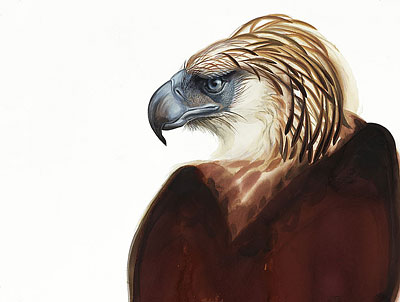
David Tomb, “Great Philippine Eagle,” 16¾ × 22½ inches. Archival digital limited edition print from an original watercolor/gouache
Then, after a successful quest for beauty, Tomb took in the downside. The Philippine Eagle, which Tomb describes as “iconic, like the panda or the tiger,” might not be around much longer. Deforestation, the presence of pesticides, mining, development, and poaching are all taking a serious toll. Before leaving the Philippines Tomb visited the Philippine Eagle Foundation in Davao where some 37 eagles — many of which have been injured and cannot return to the wild — are being used in a breeding program. On the night that Tomb’s party arrived a badly wounded adult eagle arrived. It needed emergency surgery to remove one of its wings, and the next morning Tomb’s friend Peter Barto solemnly took video of the giant maimed bird, wrapped in gauze, blinking its eyes as it came out of anesthesia.
Another sobering moment came when the group visited a defunct logging concession near the town of Bislig on Mindanao. There, they came across a vast, open, treeless landscape. The view included “…charred waist high tree stumps of smallish to medium girth and a few random very large stumps of what was the few old growth trees that survived the first clear cutting some forty to fifty years ago.” Tomb’s guide then explained that just a few months before, at the same site, he had observed a very rare Rufous-lored Kingfisher in a healthy second growth forest. “Now there was no Kingfisher and no forest,” Tomb laments.
Upon their return to California, Tomb and his friends reflected on their trip and realized that it had been a call to action. Together with Peter Barto, Howard Flax, and Ian Austin, Tomb set up “Jeepney Projects Worldwide: Art for Conservation,” an organization devoted to raising funds for the Philippine Eagle Foundation, and to educating the wider public about bird conservation in general.
Tomb’s personal webpage now has a section entirely filled with his bird-themed works of the past few years. Spread across the page are paintings of an Eared Quetzal, a Great Kiskadee, an Emerald Toucanet and many other rare creatures. The birds are rendered in stunning detail, and Tomb’s expressive line has tightened up to better suit the realism required by his new subjects. At the very top of the page, reigning like a king, is a Philippine Eagle. More than any other, this particular bird — through its majesty, its rarity, and its beauty — has opened up a new phase in Tomb’s artistic career. Somehow, an artist’s search for rare beauty brought him towards responsibility, a beautiful thing in itself.
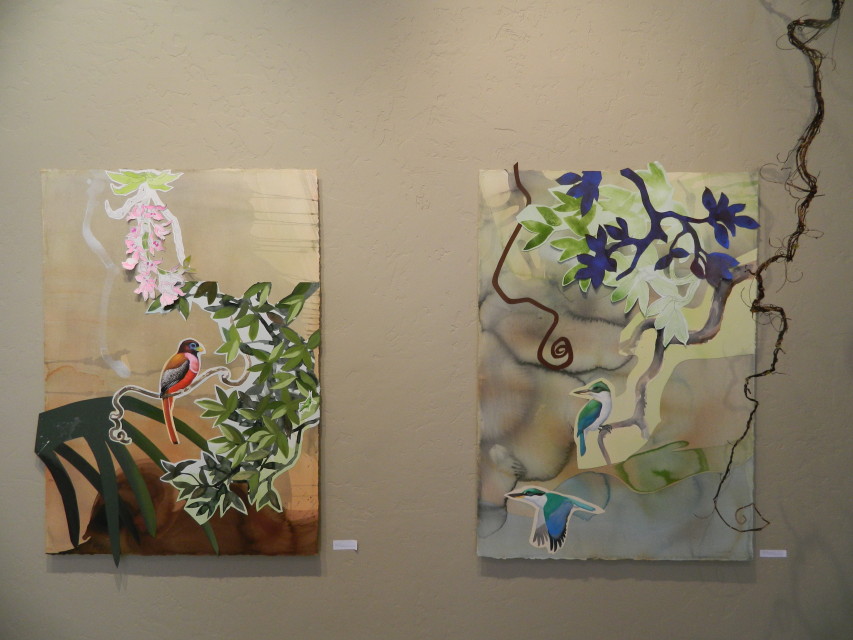
Beginning on Feb. 2, Tomb’s installation “The Bone Room Presents” in Berkeley will feature works on paper depicting not only the Great Philippine Eagle but also other rare and beautiful endemic birds of the Philippines, including the Rufous Hornbill. There will be living plants and an audio installation that will highlight sounds of the Mindanao jungle. The exhibition is meant to shine a light on the rare and beautiful birds of the Philippines and also to communicate the challenges and tensions these creatures face in order to survive and share a sustainable future with an ever growing Filipino population.
“Making artwork of the birds is a way to connect and personalize my experience of seeing the birds.” Tomb relates.“The ultimate goal is to have people think: ‘That animal is incredible.’”
***
Jeepney Projects Worldwide: Vanishing Birds of the Philippines
An Exhibition and Installation by David Tomb
Audio by Flip Baber and Johnny Random
Feb. 2 – 29
The Bone Room Presents
1573 Solano Avenue, Berkeley, California
Artist Talk by David Tomb: Thursday, Feb. 23 at 7 p.m.
FOR DEVOTED BIRD watchers, the Great Philippine Eagle is the holy grail of birds, an almost mythological creature they all have at the top of their life list.
“Of the 10,000 birds in the world, it’s the most desired bird to see,” said artist David Tomb, whose watercolor paintings of the Philippine Eagle and other exotic birds are on exhibit through Oct. 29 in an installation at Dominican University of California in San Rafael.
Among the largest and most powerful birds in the world, the great eagle is the national symbol of the Philippines. But because of the clear-cutting of hardwood forests and the seemingly inexorable destruction of its natural habitat, the iconic raptor may not be long for this world.
“There are probably only 200 of these eagles left in the wild,” Tomb lamented. “If the Philippine Eagle were to go extinct, it would be like the world losing pandas or tigers.”
The Dominican show is the official launch of Tomb’s Jeepney Projects Worldwide — Art for Conservation, a fledgling organization devoted to using the power of art to support regional conservation groups working to restore and protect the habitat of critically endangered birds like the Philippine Eagle.
Sales from the Dominican show will benefit the Philippine Eagle Foundation, an organization in the Philippine city of Davao with a captive breeding program similar to the one that saved the California Condor.
In January, Tomb and a group of friends visited the center after he fulfilled the dream of a lifetime, viewing wild Philippine Eagles on Mt. Kitanglad on the Philippine island of Mindanao.
“It took us a day and a half to see the birds,” he said. “We got a big bounce out of that.”
The threatened demise of the Philippine Eagle is particularly alarming for Tomb, a 50-year-old San Rafael High and College of Marin graduate now living and working in San Francisco’s Mission district. He’s been fascinated by the magnificent raptor since he was an 11-year-old Marin kid with a passion for birds.
“Its name used to be the Philippine monkey-eating eagle, which really caught my attention when I was a boy,” he recalled. “With its huge manelike crest, it looks like a lion with wings.”
Growing up, he participated in the Audubon Society’s annual bird counts and was inspired by Point Reyes Bird Observatory naturalist Rich Stallcup, who’s considered “the godfather of California birding.”
“I wanted to be just like him,” Tomb remembered.
After graduating from California State University Long Beach with a bachelor’s degree in painting and drawing, Tomb worked for 20 years as a portrait artist as well as an illustrator for the New Yorker, Harpers and other publications. His work is shown at Electric Works gallery in San Francisco.
Since 2005, he has devoted himself to his boyhood love — painting birds he sees on expeditions to Mexico and Ecuador in addition to the Philippines.
With Marin residents Peter Barto and Howard Flax, two friends since middle school, and Ian Austin of San Anselmo, he formed the Jeepney Project a year ago to market his art in the service of wildlife conservation.
Their organization’s namesakes are the World War-II vintage U.S. military jeeps the resourceful Filipinos have transformed into colorfully decorated taxis, now lighthearted Philippine cultural icons.
“I thought the jeepney was a great connection to the Philippines and our first big project,” Tomb explained. “And being an artist from California, you always have this thread of funk art and collage. And these jeepneys are totally funky collages.”
The Dominican installation, presented by the university’s department of art, art history and design, features some 45 paintings and drawings in a setting of tropical plants and natural sounds that mimic a Philippine forests.
“Being on a college campus, students can see how a conservation concept and an art project can merge together and develop,” he explained. “They aren’t seeing finished art work in a fancy gallery. They can see that this conservation idea just started and this art work is in process. It’s exciting that something positive can be done in terms of conservation with art work. This is the time to act.”
What: Jeepney Projects Worldwide installation by David Tomb
When: Through Oct. 29; Sept. 22: reception 6 to 8 p.m. Oct. 26: artist talk 1:30 to 3 p.m.
Where: Dominican University of California, San Marco Gallery, 50 Acacia Ave., San Rafael
Admission: Free
Information: 485-3269; www.dominican.edu
[This is an excerpt from Allie Leach’s “Birds on the Border” article from the Tucson Weekly. Please visit their link for the whole article]
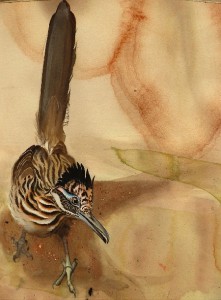 San Francisco-based artist David Tomb has loved birds since he was a young boy.
“I grew up in Oakland, Calif., and had some friends who were bird-watchers,” he said. “So we used to go out and look for owls and hawks.”
Tomb said he was also interested in art at the same age—so it’s no surprise that he became intrigued by bird artists. It’s also no surprise that winged creatures are the theme of his current exhibit, Borderland Birds, now showing at the Tucson Botanical Gardens’ Porter Hall Gallery.
Opening: Thursday, February 2, 7 – 9 p.m.
Artist talk: Thursday, February 23, 7 – 9 p.m.
For other information, please visit www.boneroompresents.com.
John Seed interviewed David Tomb about this show for an article published in the Huffington Post on January 23, 2012. Many thanks for helping to publicize the cause, John!
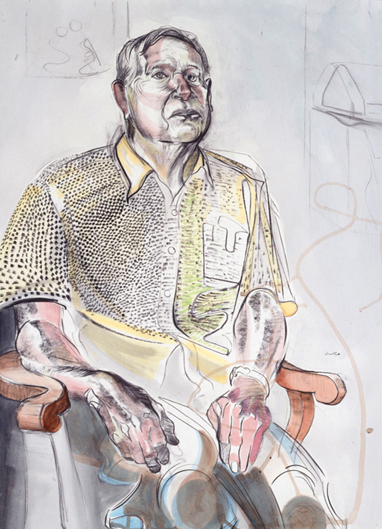
Portrait of Frank Lobdell, by David Tomb 49.25" x 29.25" mixed media on paper 2002
When David Tomb created his mixed-media portrait of artist Frank Lobdell in 2002, the experience left him wrung out. Working “on the spot” in Lobdell’s San Francisco studio, Tomb recalls that he was “so nervous, actually, that when I went home my neck went into massive seizure — doctors, painkillers, therapy for several months.”
In his effort to create a psychologically accurate portrait of a veteran painter known for his verbal reticence and monastic studio practices, Tomb had taken on a tough subject. Just what is going on, he had to wonder, in the mind of a man whose art is a perplexing mix of the inchoate and the fantastic? Looking at Lobdell’s paintings is always bracing; trying to unravel his psyche is apparently exhausting.
With his considerable effort, Tomb got Lobdell right: the strong jaw, the glowering intelligence, the unease at being scrutinized. Lobdell was “very pleased with the result” says Tomb. Of course he was: Frank Lobdell has a high respect for art that comes out of struggle and pain. Robbie Conal, who had Lobdell as his graduate advisor at Stanford in the late ‘70s says that “Frank would mutter at me, sometimes wearily, sometimes conspiratorially, every time we were together for more than half an hour; ‘Nothing worth anything is easy.’”
I also studied with Lobdell — I was an undergraduate art major around the same time that Robbie Conal was a grad student, and I remember not knowing exactly what to make of Lobdell. He was a man of few words who was hard to get to know. He made a similar impression on my classmate John Littleboy:
He [Lobdell] was broad and heavy-set and usually had a stubbled two-day growth of beard. He seemed to always have on a polo shirt and dark slacks. He might have been an athlete in his youth though that’s just a guess. I took him for independent study so we saw each other infrequently. When we did, speaking seemed to be difficult for him, requiring a big physical effort to articulate his thoughts. I never doubted he wanted to be clearly understood, but that wasn’t an easy business.
At the beginning of my semester with Lobdell I had it in my mind to try and copy a 17th century Poussin mythological painting, “Echo and Narcissus.” Thinking that it was my duty as a figurative painter to try and copy the work of a French master, I carefully sketched in the figures on a grid and had been at work for days before I found Lobdell standing beside my palette table. “Why” he asked, “would you want to paint that?” That was all he had to say, and I remember thinking “That is one great question.”
I had never seen any of Frank’s paintings, and a bit later in the term I dropped by his office hour thinking he might have one of his canvasses hung in his office. Lobdell was lost in some paperwork when I got there, so I looked around and waited. On the right hand wall was an early Diebenkorn abstract oil — it was a terrific painting — but there were no Lobdells in sight. “This man has a rich history,” I began to realize, “that is worth looking into.”
After my Poussin copy went into the dumpster I tried an abstract picture, and it quickly turned into a chaotic mess. When Frank stopped by to see what I was painting I complained to him and pointed out all of the areas that I thought were unresolved. He got right to the point: “Find an area of the painting that you like,” he told me. “I will be back in an hour.” I followed his instructions, and when he returned I located one area of the painting where the paint had accidentally fallen into place in an interesting way. “Hang on to that,” Lobdell advised.
One of Lobdell’s strengths, I gradually learned, was his ability to break down a canvas, scrutinize small areas and understand how they could add up. Susan Harby, who studied under Lobdell as a graduate student, also noticed this strength:
He lived and painted a micro and macroscopic life on the canvas of forms playing out a drama or game. He looked at my work for the interaction of the small things that added up to make a good painting. He would stand inches away from the painting’s surface investigating the small forms or small brushmarks and discuss how they enlivened the surface. They had to add up to something: something truthful.
In this struggle for artistic veracity Lobdell could work up a temper. He was quiet and kind in class, but in his studio he would cut loose. One Saturday I had a job cleaning up Nathan Oliveira’s studio in an old VFW building in Palo Alto. Lobdell and Keith Boyle, another Stanford art professor, had studios across the hall. I remember hearing a crashing sound from across the hall — “Was that a painting hitting the wall?” I wondered — followed by Lobdell’s voice screaming out a string of curses.
Oliveira once told me that he and Frank liked to share some whiskey at the studio from time to time, and one memorable evening they drank half a bottle and realized that the liquor had unlocked their tongues. Nathan turned on a tape recorder to preserve the profound revelations about art that were unfolding, but when he ran the tape a few days later. The results were hilariously disappointing.
“When I make art,” Nathan heard his drunken voice intone, “I…(long silence)…………”
“YESSSSSS,” Lobdell assented solemnly.
Robbie Conal, also remembers spending time in Frank’s studio, talking art over a few drinks:
We’re sitting at what might have been a folding card table, whatever’s left of a 5th of bourbon between us: I brought it. Ruminating — deeply — until Frank growls, “Let’s listen to some Beethoven; the late quartets.”
He gestures me over to the record player. I turn it on and drop the arm on spinning black vinyl.
Frank booms, “Opus 131 in C# minor!” We listen for maybe 10-12 minutes in silence, he’s nodding his head, eyes closed. Then, seemingly from within his reverie he says, “I know people think my work isn’t pretty… that it doesn’t go with the damn drapes… but when I need something for my soul — not for fucking entertainment, you know? — for my soul… I go to Beethoven! That’s what my damn art is about.”
At the end of the term Lobdell invited my class to visit his studio — an exciting moment. He was genuinely liked, even loved, by his students, and we had passed the hat and bought him a large stainless steel frosting knife that we thought would make a good painting tool. Frank loved the knife — it was the most gigantic palette knife ever — and was visibly touched when he unwrapped it.
At his studio that day, Lobdell gave the single most riveting painting demonstration I have ever seen. Placing a canvas flat on the floor, Jackson Pollock style, he scraped some raw oil paint onto the surface and said approvingly “That’s a start.” In the studio, it was as if we students had disappeared: he was letting us into the privacy of his creative process.
“Hmm…… (silence)…..green…… needs yellow.” Each time he laid down some paint, it suggested his next move, and each addition was grudgingly, tentatively applied. At first I remember thinking that Lobdell was intuitive, but as I watched the demonstration unfold it hit me: he was counterintuitive. Every scab of paint demanded a response, but the key was that the response had to be strained and unexpected. Lobdell was a tense painter, and it was the tension of the unexpected that kept him alive to his own work. His demonstration painting, as it began to add up, was simultaneously essay in imperfection and a manifesto of sincerity.
Lobdell was “succinct” says Robbie Conal.
During a one-on-one meeting with Frank, in his studio, after staring at a big new painting of his together for 20 minutes without saying a word, I asked him a question, “How do you get those fast black linear brush strokes in exactly the right place every time?”
The answer, “I paint them slow.”
Lobdell, who told an interviewer in 1960 that “being anonymous is really the best condition to be able to create” was not showing very widely when I knew him, although I do remember him having a small show of monotypes at Galerie Smith Andersen in Palo Alto. Robbie Conal, who served as a Gallery Director for the College of Notre Dame in Belmont in 1979 had to work on Lobdell to convince him to show his 1961 “Summer Mural,” a 20-foot-wide phallic abstraction. “I can’t quite imagine how I managed to trick him into showing the Big Dick,” Conal recalls, “but I somehow talked Frank into unfolding and re-stretching the painting and actually showing it.”
I don’t remember seeing Lobdell at graduation, and in general I think he tried to avoid social situations, and to some degree his students. “He left me an index card with my grade for the quarter on my glass palette” recalls John Littleboy. “ I took by his demeanor that painting wasn’t an easy task and whatever I did should be done with sincerity and dedication.”
Twenty years later, at the opening of an exhibition of The Anderson Collection at San Francisco MOMA, I saw the first Lobdell painting I had seen in more than two decades. A magnificent yellow and blue abstraction titled simply “January, 1971” it more than held its own among the top flight works by Still, Rothko, Pollock and other postwar abstractionists. I looked for Frank to see if I could congratulate him, but was told that he had missed the opening due to hip replacement surgery.
In June 2003, Lobdell’s work popped up again: on the cover of ARTnews magazine. In a feature article titled “The Long Distance Runner” Anneli Rufus wrote this about Lobdell:
Oblivious to art-world trends, Frank Lobdell has spent more than half a century doing what he wants, constantly reinventing himself and finding new territory to explore.
The re-discovery of Frank Lobdell, my stoic painting teacher had begun and the accolades followed. In his introductory essay for the book Frank Lobdell: the Art of Making and Meaning Bruce Guenther writes, “To encounter a Lobdell painting today is to engage at the highest level in a complex dance between structure and symbolism, form and meaning.”
Even more extraordinary than the praise being heaped on Lobdell were the revelations about what he had seen while serving as a GI between 1942 and 1945. In a superb essay also published in Making and Meaning Timothy Anglin Burgard recounts Lobdell’s experience, in April of 1945, of entering a barn in Gardelegen, Germany where Nazi troops had immolated more than 1,000 concentration camp internees. I now fully understand why Lobdell, like many young American painters of the postwar generation, had chosen abstraction over figuration. When you have seen the un-seeable, painting reality becomes excruciating.
When Willem de Kooning painted his epic “Excavation,” an abstracted image of a mass grave, he had only seen news photos of what happened in Germany. Lobdell had seen Hell on Earth with his own eyes, and it chilled his soul. When he created his “Dance” series during the Viet Nam era — inspired by medieval images of the ‘Dance of Death’ — Lobdell’s darkest memories charged the abstract imagery.
“No one who is involved in one of these wars truly survives” Lobdell once told writer Terry St. John.
Lobdell, who will be 90 in August, made an appearance at Hackett-Mill Gallery last month, where he attended the opening of “Frank Lobdell: 1948-49,” an exhibition of a few choice works he made more than 60 years ago. Jessica Phillips, the Associate Director of the gallery reports that Lobdell “enjoyed seeing the work and speaking with collectors and of course former students.” Part of Lobdell’s legacy is certainly his influence of generations of art students: he taught at the California School of Fine Arts from 1957 until taking a job at Stanford where he taught until 1991.
“Frank Lobdell was one of my instructors at the San Francisco Art Institute in 1963,” says veteran artist Ronald Davis. “He influenced my student work before I was in his class, and began doing op art. I remember that he told me that, to paraphrase; ‘Sometimes it is not what one puts into a painting, but rather what one leaves out that makes it a compelling picture.’”
Truthfully, part of Lobdell’s power as a man — and as an artist — is that he told us so little for so long. It is energizing, and exhausting, to read between the brushstrokes of a man who meant every word and every brushstroke. He struggled over every single one of them.
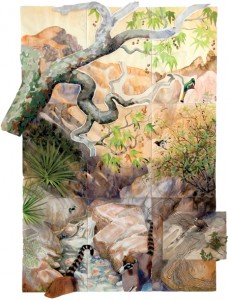
Border Troop, 2009, Graphite, ink, colored pencil, gouache and watercolor wash, 132" x 96" overall, Photo courtesy Electric Works
Between cynicism and hypocrisy lies the 2,000-mile U.S.- Mexico border. America is raising a wall in the desert to separate Mexican drug exporters from American drug consumers, to separate Latin American peasants who will work for low wages from the Americans who would hire them.
The Great Wall of America, straddling less than half the length of the border, descends into canyons and across the desert floor. For the Mexican, it represents a high hurdle. For the American, it is an attempt to stop the Roadrunner’s progress with an Acme Border Sealing Kit.
In some places the wall is made of tennis-court-style cyclone fencing or dark mesh of the sort used for barbeque grills in public parks. In other places the wall is a palisade of 20-foot-tall bars that make a cage of both sides. The most emphatic segments are constructed of graffiti-ready slabs of steel.
On the Mexican side, if you stand with your back to the wall, you will see the poorest neighborhoods, built right up to the line. These frayed, weedy streets have become the killing fields in an international drug war; they are more daunting than the dangers of climbing the wall.
The traditional Mexican accommodation to moral failure — the bribed policeman — has degenerated to lawlessness in places such as Juarez and Tijuana, where police kill federal soldiers who kill police who kill drug gangsters who kill other gangsters of the sort who did kill, apparently with impunity, at least 15 teenagers celebrating a soccer victory. Punch 911 and you get the devil.
On the American side, if you stand with your back to the wall, you will see distance, as the United States recedes from the border. There is a shopping mall with big-box stores half a mile away. There is a highway that eventually leads to suburban streets laid out in uniform blocks, and cul-de-sacs where Mexican gardeners are the only ambulatory human life.
The suburban grid belies America’s disorder. Grandma’s knockoff Louis Vuitton handbag is so full of meds it sounds like a snake rattle. Grandma shares a secret addiction with her drug-addled dude of a grandson, whose dad prowls the Home Depot parking lot in his Japanese pickup, looking to hire a couple of Mexicans to clear out some dry scrub.
In the remotest regions of northern Mexico, the terrain is so treacherous that nature itself forms the wall against America. Desperation moves migrants to attempt ever-more-treacherous terrain to achieve U.S. soil.
In recession America 2010, the lament most often heard is that the middle class is losing its grip on the American dream. (We have redefined the American dream as the ability of a succeeding generation to earn more than its preceding generation.)
On patriotism-for-profit talk radio and television, the illegal immigrant is, by definition, criminal. She comes to steal the American dream. But in my understanding, the dream belongs to the desperation of the poor and always has. The goddess of liberty in New York harbor still advertises for the tired and the poor, the wretched refuse. I tell you, there is an unlucky man in the Sonoran Desert today who will die for a chance to pluck dead chickens in Georgia or change diapers in a rest home in Nevada.
Great empires expand beyond their own borders. Empires in decline build walls.
As it stands, the Great Wall of America is a fraction of the length of the Great Wall of China. China’s dragon-spined ramparts, once a wonder of isolation, are now a draw for tourists, even while China trespasses its own borders to forge the Chinese century. The dragon flies to Africa and to Latin America. While American soldiers die in Afghanistan, the Chinese venture to Kabul to negotiate mineral rights.
The nearer precedent to the American Wall may be Israel’s wall in the West Bank. More than 400 miles long, the Israeli “barrier” — in some places a fence, in others a concrete mass nearly twice the height of the Berlin Wall — was constructed, according to Israeli officials, to deter terrorists. After Sept. 11, the fear one heard in America was that agents of violence from the Middle East might easily disguise themselves as Latin American peasants and trespass into our midst.
What more obvious reason is there for a wall than protection? Any nation should police those who come and go across its borders. But in the United States, as in Israel, the wall has created a new anxiety. Once the wall is in place, anxiety about the coming outsider changes to an anxiety about who belongs within.
The question that has lately been debated in the Knesset is bluntly stated: Who is a Jew? In Israel, the answer to the question concerns religion and citizenship. But it entails further practical considerations. Israel has decided to rid itself of 400 children of illegal foreign workers (some of whom built the West Bank wall), children who were born in Israel, speak Hebrew as their mother tongue and know no other country.
The question that has lately been taken up by U.S. senators is bluntly stated: Who is an American? Republicans have proposed excising the part of the 14th Amendment that guarantees citizenship to anyone born on U.S. soil. GOP Sen. Lindsey Graham of South Carolina refers to foreign women who come to this country to “drop” their babies. Graham chooses diction that describes inhuman beasts of burden.
I cannot guess whether this new nativism — though it overrules nativity — is serious business or merely a play for reelection. The irony remains: The land of the free that the wall was built to protect — the literal “homeland,” soil so infused with sacred legend it was deemed by the makers of the Constitution more important than blood in determining citizenship — is threatened from within. And the wall that is supposed to proscribe the beginning of America becomes the place where America ends.
Richard Rodriguez is the author of many books, including “Brown: The Last Discovery of America.” He works for New America Media in San Francisco.
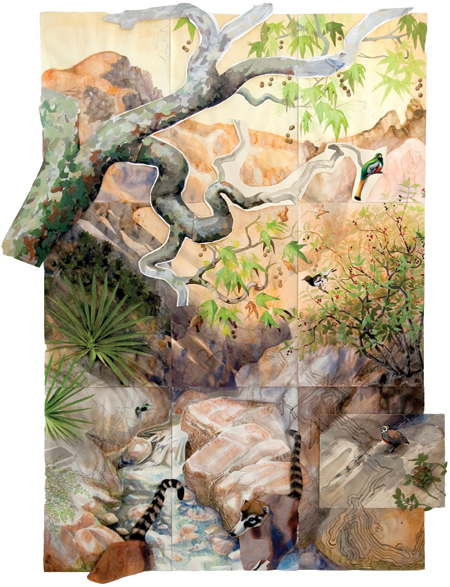
Border Troop, 2009, Graphite, ink, colored pencil, gouache and watercolor wash 132" x 96" overall, Photo courtesy Electric Works
Barnett Newman’s famous joke about art history being irrelevant to artists, just as ornithology is to birds, has always been irrelevant to ornithologists, even if it ruffled art historians’ feathers. But current events have cast further doubt on its accuracy. Not only does the proliferation of contemporary art require more analysis than ever, but the dwindling avian universe needs professional expertise, too, in warding off extinction. For too long we’ve ignored the canaries in the coal mine–even though some, admittedly, were amphibians, with extra legs.
Portraitist David Tomb may not be a dedicated wildlife artist like Audubon or Fuertes, but he is a dedicated birder who has created mixed-media paintings on paper (complemented by tropical plants, stuffed birds, and recorded birdsong) based on his pilgrimages to bird habitats in Mexico’s Chihuahua, San Blas, Jalisco, and El Triunfo. This show examines the wildlife of northern Mexico, mostly avian, but also pedestrians like the roadrunner and Gila monster. More typical are depictions on medium-sized or large sheets of watercolor paper that place their perched, paused subjects–e.g., aplomado falcon, chachalaca, vermilion flycatcher, great kiskadee, tropical parula, and crimson-collared grosbeak–atop contorted branches and sprays of foliage before blank or blurred backgrounds. The birds are rendered accurately enough to suit any birder, but without the hyperreal detail that Audubon captured, having shot his models–or his anthropomorphic sense of drama. Instead, Tomb depicts moments of stasis–birds caught by the camera and given a larger, eternal context via artistic license, with the artifice occasionally revealed, as in Border Troop, a monumental collage of unretouched fragments, or the single-sheet Ferruginous Pygmy Owl and Green Jays, clearly a composite view. Tomb’s goal in both painting and politics is clearly preservation; he combines art and environmentalism in a way that is accessible both to children, who have flocked to the show with their schoolmates, and to wary, solitary adults working their way down their “life lists” of must-see art.