"> - Part 4

Author Archive

The ‘Great Wall of America’ and the threat from within Cynicism, hypocrisy and an entirely un-American urge to exclude are the foundation of the barrier that stretches along the border with Mexico.

Posted on:
Border Troop

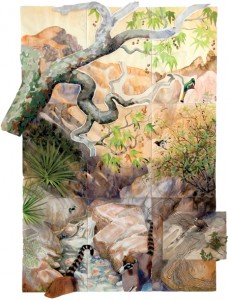
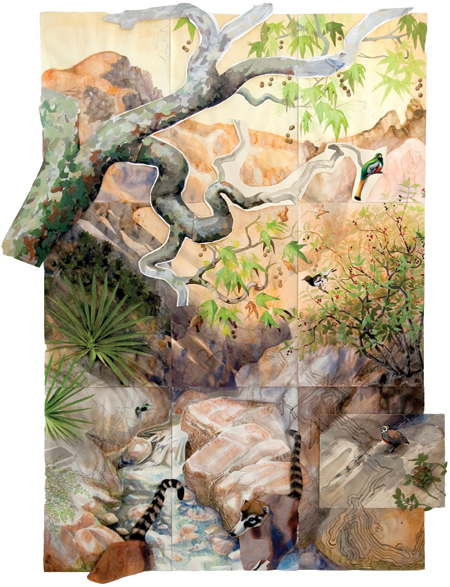
Border Troop, 2009, Graphite, ink, colored pencil, gouache and watercolor wash, 132" x 96" overall, Photo courtesy Electric Works

Between cynicism and hypocrisy lies the 2,000-mile U.S.- Mexico border. America is raising a wall in the desert to separate Mexican drug exporters from American drug consumers, to separate Latin American peasants who will work for low wages from the Americans who would hire them.

The Great Wall of America, straddling less than half the length of the border, descends into canyons and across the desert floor. For the Mexican, it represents a high hurdle. For the American, it is an attempt to stop the Roadrunner’s progress with an Acme Border Sealing Kit.

In some places the wall is made of tennis-court-style cyclone fencing or dark mesh of the sort used for barbeque grills in public parks. In other places the wall is a palisade of 20-foot-tall bars that make a cage of both sides. The most emphatic segments are constructed of graffiti-ready slabs of steel.

On the Mexican side, if you stand with your back to the wall, you will see the poorest neighborhoods, built right up to the line. These frayed, weedy streets have become the killing fields in an international drug war; they are more daunting than the dangers of climbing the wall.

The traditional Mexican accommodation to moral failure — the bribed policeman — has degenerated to lawlessness in places such as Juarez and Tijuana, where police kill federal soldiers who kill police who kill drug gangsters who kill other gangsters of the sort who did kill, apparently with impunity, at least 15 teenagers celebrating a soccer victory. Punch 911 and you get the devil.

On the American side, if you stand with your back to the wall, you will see distance, as the United States recedes from the border. There is a shopping mall with big-box stores half a mile away. There is a highway that eventually leads to suburban streets laid out in uniform blocks, and cul-de-sacs where Mexican gardeners are the only ambulatory human life.

The suburban grid belies America’s disorder. Grandma’s knockoff Louis Vuitton handbag is so full of meds it sounds like a snake rattle. Grandma shares a secret addiction with her drug-addled dude of a grandson, whose dad prowls the Home Depot parking lot in his Japanese pickup, looking to hire a couple of Mexicans to clear out some dry scrub.

In the remotest regions of northern Mexico, the terrain is so treacherous that nature itself forms the wall against America. Desperation moves migrants to attempt ever-more-treacherous terrain to achieve U.S. soil.

In recession America 2010, the lament most often heard is that the middle class is losing its grip on the American dream. (We have redefined the American dream as the ability of a succeeding generation to earn more than its preceding generation.)

On patriotism-for-profit talk radio and television, the illegal immigrant is, by definition, criminal. She comes to steal the American dream. But in my understanding, the dream belongs to the desperation of the poor and always has. The goddess of liberty in New York harbor still advertises for the tired and the poor, the wretched refuse. I tell you, there is an unlucky man in the Sonoran Desert today who will die for a chance to pluck dead chickens in Georgia or change diapers in a rest home in Nevada.

Great empires expand beyond their own borders. Empires in decline build walls.

As it stands, the Great Wall of America is a fraction of the length of the Great Wall of China. China’s dragon-spined ramparts, once a wonder of isolation, are now a draw for tourists, even while China trespasses its own borders to forge the Chinese century. The dragon flies to Africa and to Latin America. While American soldiers die in Afghanistan, the Chinese venture to Kabul to negotiate mineral rights.

The nearer precedent to the American Wall may be Israel’s wall in the West Bank. More than 400 miles long, the Israeli “barrier” — in some places a fence, in others a concrete mass nearly twice the height of the Berlin Wall — was constructed, according to Israeli officials, to deter terrorists. After Sept. 11, the fear one heard in America was that agents of violence from the Middle East might easily disguise themselves as Latin American peasants and trespass into our midst.

What more obvious reason is there for a wall than protection? Any nation should police those who come and go across its borders. But in the United States, as in Israel, the wall has created a new anxiety. Once the wall is in place, anxiety about the coming outsider changes to an anxiety about who belongs within.

The question that has lately been debated in the Knesset is bluntly stated: Who is a Jew? In Israel, the answer to the question concerns religion and citizenship. But it entails further practical considerations. Israel has decided to rid itself of 400 children of illegal foreign workers (some of whom built the West Bank wall), children who were born in Israel, speak Hebrew as their mother tongue and know no other country.

The question that has lately been taken up by U.S. senators is bluntly stated: Who is an American? Republicans have proposed excising the part of the 14th Amendment that guarantees citizenship to anyone born on U.S. soil. GOP Sen. Lindsey Graham of South Carolina refers to foreign women who come to this country to “drop” their babies. Graham chooses diction that describes inhuman beasts of burden.

I cannot guess whether this new nativism — though it overrules nativity — is serious business or merely a play for reelection. The irony remains: The land of the free that the wall was built to protect — the literal “homeland,” soil so infused with sacred legend it was deemed by the makers of the Constitution more important than blood in determining citizenship — is threatened from within. And the wall that is supposed to proscribe the beginning of America becomes the place where America ends.

Richard Rodriguez is the author of many books, including “Brown: The Last Discovery of America.” He works for New America Media in San Francisco.
David Tomb: “Borderland Birds/Aves Fronterizas” at Electric Works

Posted on:
Border Troop

Border Troop, 2009, Graphite, ink, colored pencil, gouache and watercolor wash 132" x 96" overall, Photo courtesy Electric Works

Barnett Newman’s famous joke about art history being irrelevant to artists, just as ornithology is to birds, has always been irrelevant to ornithologists, even if it ruffled art historians’ feathers. But current events have cast further doubt on its accuracy. Not only does the proliferation of contemporary art require more analysis than ever, but the dwindling avian universe needs professional expertise, too, in warding off extinction. For too long we’ve ignored the canaries in the coal mine–even though some, admittedly, were amphibians, with extra legs.

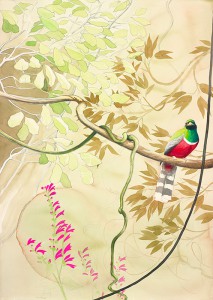
Portraitist David Tomb may not be a dedicated wildlife artist like Audubon or Fuertes, but he is a dedicated birder who has created mixed-media paintings on paper (complemented by tropical plants, stuffed birds, and recorded birdsong) based on his pilgrimages to bird habitats in Mexico’s Chihuahua, San Blas, Jalisco, and El Triunfo. This show examines the wildlife of northern Mexico, mostly avian, but also pedestrians like the roadrunner and Gila monster. More typical are depictions on medium-sized or large sheets of watercolor paper that place their perched, paused subjects–e.g., aplomado falcon, chachalaca, vermilion flycatcher, great kiskadee, tropical parula, and crimson-collared grosbeak–atop contorted branches and sprays of foliage before blank or blurred backgrounds. The birds are rendered accurately enough to suit any birder, but without the hyperreal detail that Audubon captured, having shot his models–or his anthropomorphic sense of drama. Instead, Tomb depicts moments of stasis–birds caught by the camera and given a larger, eternal context via artistic license, with the artifice occasionally revealed, as in Border Troop, a monumental collage of unretouched fragments, or the single-sheet Ferruginous Pygmy Owl and Green Jays, clearly a composite view. Tomb’s goal in both painting and politics is clearly preservation; he combines art and environmentalism in a way that is accessible both to children, who have flocked to the show with their schoolmates, and to wary, solitary adults working their way down their “life lists” of must-see art.


Bird lover and painter David Tomb on borders, coffee, and of course, birds

Posted on:

I love birds. I love everything about them. I love to hear them. I love to see them. I love that they can fly. I love the sound of the word bird. I love Charlie Parker. So when I read that fellow bird lover and painter David Tomb was having a show at Electric Works called Borderland Birds/Aves Fronterizas, I put in my request for an interview. Tomb’s exhibition will consist of drawings and installation and will focus on the birds Montezuma Quail, Aztec Thrush, Aplomado Falcon and the racoon-like coati—all creatures who make the United Sates Southwest and Mexico home–borderland creatures. First thing I wanted to know, of course, is why he loves birds.

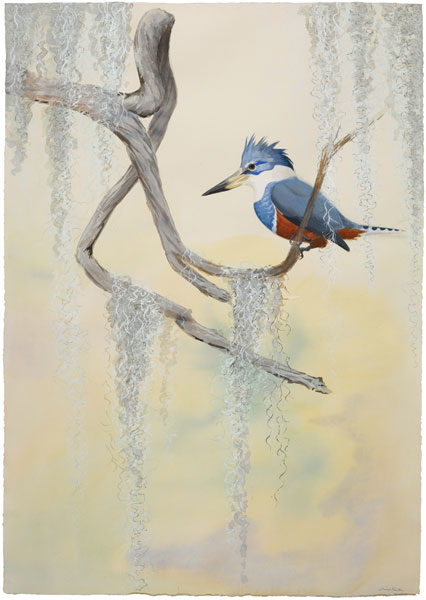
Ringed Kingfisher

“Ringed Kingfisher,” 2009, graphite, watercolor, gouache on paper, 44" x 30"

S.A. Why birds?

D.T. Well, birds are the bees’ knees! They can fly and they are the closest living relatives to dinosaurs. What else do you want? I have a memory from childhood that is like a gothic vision. A group of turkey vultures that, every morning, would sun their outstretched wings in a gnarled snag of an oak tree. My mom tells me that I was mesmerized by this. I just think that birds are a beautiful expression of life. A couple of years ago, I was lucky to encounter the ethereal song of the brown-backed solitaire and see a resplendent quetzal flying through a cloud forest canopy with its tail shimmering and undulating. These are very rich aesthetic experiences for me. In terms of art, birds translate well as a decorative and metaphoric motif. Birds are inspiring.

S. A. What can we expect to hear and see at the Electric Works show?

D. T. The works on paper (approximately 14 pieces) in the exhibition will feature a number of birds that can be found, at least part of the year, near the border regions. Specifically the Lower Rio Grande Valley in Texas and the Sky Islands in Arizona. In addition, there will be one large-scale piece — 11 feet high by 9 feet wide — of a vignette mountain canyon scene with birds and critters. This piece will have a sound component that is triggered by a motion detector. The sounds will be mostly bird songs, a rushing creek, [that sort of thing]. There will also be a selection of desert plants to augment the pictures and sounds. I like this part because you can smell the soil, water, and plants. It adds a lot and helps transport the viewer into another realm.

S.A. Tell me about your grandfather, the painter Sydney Lemos. Any other artists in the family?

D. T. Well, I never got to meet Sydney Lemos, but as a kid I looked at his paintings in our house. Sydney was a very good California Impressionist landscape painter. The bulk of his career was between 1920 and 1944 when he died. He went to the San Francisco Art Institute and was friends with Pedro Lemos (no relation) and Maynard Dixon. Sydney’s parents Mabel and William were both artists in Santa Cruz. William was the big personality raconteur type and he was one of the first vendors at the Santa Cruz Boardwalk. William’s sister, who lived in Chicago, was an artist as well. Their parents were both artists also. My mother thinks that one of their parents was an artist as well. OK, back to the future — my brother, Bruce, is an architect/artist and his son, Jason, just got accepted to art school in San Francisco. Whew!

S.A. Why does the U.S./Mexico border fence spell disaster for the environment?

D.T. I can give you two examples of problems that the border fence presents to earthbound creatures. There are natural animal corridors that animals such as the jaguar use to travel north and south through that region. This fence will stop that natural migration for the jaguar, which can result in either complete isolation of this small population of jaguar in the U.S. or the extirpation of this species in the U.S.

In Texas, at Sabal Palm Audubon Center near Brownsville, the construction of the fence will do the same to the ocelot and jaguarundi population. In addition, huge swaths of rich habitat will be clear-cut in all of the areas where the fence is built. This will prevent animal access to the Rio Grande River, which is crucial for their survival. Where the fences are built, there are large denuded areas of land — many creatures will not pass through these areas because they would be too vulnerable to predators — this completely alters the historic environmental landscape.

S.A. That’s ironic that it takes environmentalists and animal rights activists, not human rights activists, to call attention to the wall, which I know isn’t the total truth. Human rights activists have done their part, but still.

D.T. I’m not an expert on this topic but I believe there are plenty of human rights activists and environmentalists [both] that are voicing their concerns regarding this. Obviously, they have not persuaded the key people who can stop or reverse the construction. Here is another disturbing aspect of the fence: It is creepy to look at. This is no ethereal poetic running fence by Christo. It is certainly no meandering, hand hewn, charming, stonewall with ferns and moss tucked away. One glance at this would make anything, furry or otherwise, turn around, run and scream.

S.A. I agree the wall is creepy and it certainly doesn’t address the situation or do anything to lift up the standard of living in Mexico that leads people to risk their lives to come to the U.S. Seems like resources could be better utilized elsewhere.

D.T. There are people that complain about how money is misused or wastefully spent. This should be nearly at the top of the list. Sheesh. I buy coffee from Capulin Coffee, a coffee finca based in West Mexico. The owner once said to me that since his small company employs many of the people in the town/village no one in the town has an interest in getting into the U.S. This is a very small reminder that there are lots of ways one can help the situation.

S.A. Are there any superstitions about birds that you respect? What are some of your favorite bird folklores?

D.T. Of course, birds and culture have long been interwoven. I think it is difficult not to see birds through this prism. Owls are thought to be both wise and mysterious. If you have ever had an up close and personal connection with a great-horned owl you can see in its eyes that this is one shrewd beast. Owls seem to be imbued with an ancient presence that is indescribably powerful.

The way that artists have depicted birds and etched them into culture resonates with me more than a lot of superstitions. I remember as a kid seeing images of the Egyptian God Horus depicted as a falcon-headed man. I just gassed on the stylized look and thinking how cool it was that there was this God that was part falcon. My family went to Vancouver when I was a kid and I saw eagles that were carved into totems. That was so memorable. The Edward Curtis’s staged photos of chiefs with eagle feather headdresses are jaw-dropping pictures — it was obvious that these chiefs also knew that eagles were great! And I spent so much time looking at Roger Tory Peterson’s Field Guide to Western Birds. I loved the simple flat schematic profiles of birds. Much of the appeal of birds is looking at how others have seen them.

There is also the legend of the Tower of London where there are resident ravens and there is even a ravenmaster who takes care of them. The legend says that if the ravens ever leave the towers that the monarchy will fall. It is an amazing image to see the ravens strutting around the towers where traitors and witches were executed — they act like the own the joint. Those bad boys look formidable especially in this context. I find this legend very appealing and I don’t think you have to be in the goth or Dungeons and Dragons crowd to get the sense of wonder here.

S.A. The ravenmaster certainly has a lot of pressure on him. And there are so many bad superstitions about ravens, but the whole British monarchy rests on a few of them. Talk about superstitious.

D.T. Yes, ravenmaster must be a stressful job. I read that he had to make serious provisional plans to protect the birds from the avian influenza.

S.A. Final question: Is there any bird you haven’t seen that you’re chasing down?

D.T. There are so many spectacular birds, but I have started working on an art project to benefit the Philippine Eagle Foundation in Mindanao. The Philippine eagle is critically endangered mostly due to habitat loss/forest destruction but also because of hunting. This is a truly magnificent bird. The Natural History Museum of Los Angeles County has a skin (stuffed) of one of the beauties that I got to study and draw. They’re huge chocolate brown birds with a massive bluish beak and a lion-like mane. I am trying to get a buddy from 7th grade to come along on a research trip to see this gnarly beast. Hey, no pressure, Pete!

The opening reception for Borderland Birds/Aves Fronterizas will be on Friday, April 16th, from 6 to 8 p.m. and is free and open to the public. The show will be up until May 29, 2010. Electric Works is located at 130 Eighth Street (cross street is Mission). David tells me that ordering coffee from from Capulin Coffee is very easy; he’s never had a problem. You just fill out this simple order form or email them. They’ll contact you for payment information. The coffee gets delivered by FedEx.

Much more information on birds can be found here. Interesting picture of the wall is here. More photos of the border wall, creepy and otherwise, can be found by clicking this. And here is some recent news on the wall. Looks like they are going high tech—less wall, more cameras, laptops and thermal-imaging devices.

David Tomb’s New Work

Posted on:
mountain trogon

“mountain trogon,” graphite, ink, colored pencil, gouache and water color wash, 42"x30" 2007-2008

I first became aware of artist David Tomb thanks to his portraits some years ago. It was impossible not to recognize something special in them, even beyond the artist’s formidable draftsmanship. In particular, the portraits of his favorite subject capture subtle states one recognizes immediately, most often subtle varieties of preoccupation with one or another unseen riddle. It’s that state of having one’s thoughts quietly elsewhere. Conveyed, too, is the strong sense that we, as viewers, look in on the subject caught unobserved and alone in his pondering. These drawings have a quality hard to pin down, perhaps of a gentle and compassionate impartiality.

Tomb’s portraits have gotten a fair amount of attention, especially here in the Bay Area, and so when I learned that he had turned his attention to a new subject, birds, I was curious. I wanted to know what was behind his new direction.

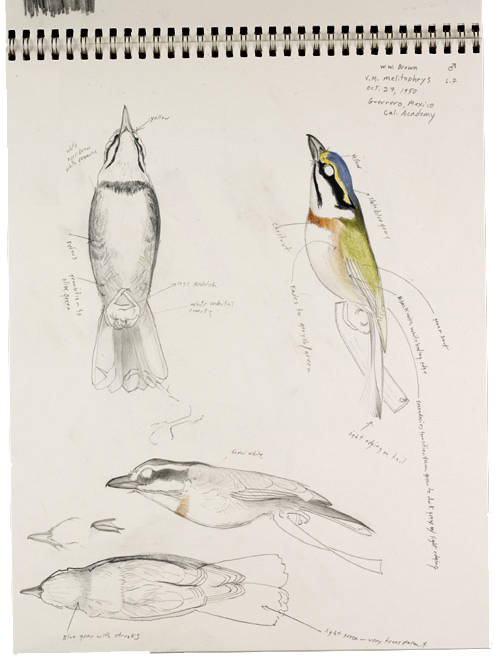
Study: chestnut-sided shrike-vireo

“Study: chestnut-sided shrike-vireo,” graphite, colored pencil, 13.5"x10" 2006-2007

A phone call led to a studio visit. It was the second or third time I’d met and talked with Tomb, and I was reminded once again just how enjoyable a visit with an artist in his or her studio can be.

What I remember is how Tomb explained that bird watching was one of his longstanding interests, something I can easily understand. Whenever a bird lands in the branches outside the window, aren’t one’s eyes attracted there immediately and linger with a kind of delight? It’s one of those pleasures that never gets old. And sometimes there’s a special treat like the yellow flash of a goldfinch or the charm of a tiny chickadee.

Tomb talked about the rekindling of a passion, and how this carried him to the El Triunfo Biosphere Reserve in the Sierra Madre Mountains of Chiapas, Mexico. There, he saw first hand an amazing variety of birds he’d never seen before. All in all, it’s clear the artist has given himself over to an entirely new direction.

Chiapas

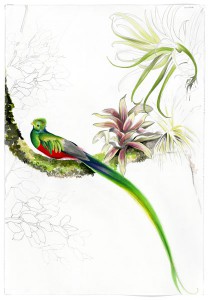
“Chiapas, resplendent quetzal,” graphite, ink, colored pencil, gouache and water color wash, 44"x33" 2006-2007

Listening to Tomb’s enthusiastic descriptions raised my own spirits, too. But what about the artworld? I wondered. Tomb’s drawings have the look of accomplished illustrations. Where was the offbeat stance, the conceptual conceit, or some other indication that the work was art?

We both had a rueful laugh over this–a taste of freedom! It seems Tomb wasn’t worrying about these questions. His drawings are born of enthusiasm in the old sense of the word, en theos.

Listening to him talking elatedly of his experiences, I suddenly wondered if any of it translated to a concern for issues of the environment. Of course, the answer was emphatically yes.

60% of the cloud forests of Mexico have disappeared, I learned. El Triunfo Biosphere Reserve preserve in Chiapas is one that is being preserved. Even the mythic quetzal can still be seen there, the bird venerated by the ancient Mayas and Aztecs as the God of the Air and associated, too, with the snake god Quetzalcoatl. They’re not easy to find, even there, but Tomb had seen one himself.

I forget exactly how he put it when we talked about this new work, but “I feel completely refreshed” is close enough.

Four artists put new works on display at Michael Berger Gallery

Posted on:

At the Michael Berger Gallery in Point Breeze, the exhibit “mind/body/spirit” examines the collective state of consciousness through the work of four different artists.

For example, Huang Xiang and William Rock live in Pittsburgh, but couldn’t be more different. Huang is a dissident Chinese poet who spent more than 10 years in prison for refusing to submit to the Communist Party propaganda machine. Rock is a dual citizen of Ireland and the United States. Yet these two artists’ works come together wonderfully in nine larger-than-life portraits on display.

Six of them take up an entire room in the back of the gallery, offering a place of contemplation on the lives of the persons depicted: Martin Luther King, Elizabeth Barrett Browning, Mohandas Gandhi, Emily Dickinson, William Shakespeare and Isadora Duncan.

Each portrait was painted by Rock, but the calligraphic writing of Huang’s poetry is by Huang, with translated excerpts from each hanging next to the canvases.

For example, next to Elizabeth Barrett Browning’s it reads: “Sadness, sadness … sadness; Elizabeth, Elizabeth, Elizabeth; your love story is like; of nightfall the memory of a spider comes dripping …”

Many Pittsburghers know Huang is the first writer to be sponsored by Cities of Asylum/Pittsburgh, living in a North Side rowhouse, provided by the group, that is just a few doors down from the Mattress Factory. But what most don’t know, is that Huang, 65, will soon leave Pittsburgh for New York City, with the intent of furthering his career, making this one of the few chances left to find out more about this most interesting artist and a city resident.

Another artist in the exhibition who left Pittsburgh for New York is Philip Pearlstein. Of course, that was more than a half-century ago when Pearlstein skipped town with a young Andy Warhol, sharing an eighth-floor walkup tenement apartment on St. Mark’s Place in the summer of 1949.

Born in Pittsburgh in 1924, Pearlstein has returned many times over the years, mostly at the prompting of scores of enthusiastic collectors here who are fascinated with his work.

Gallery owner Michael Berger is one of them, having not only collected, but shown Pearlstein’s work for nearly three decades.

“Pearlstein is strictly surface,” Berger is quick to point out — a rationalization of sorts about the nine prints by the artist on display.

The most memorable of these works may be “Models with Mirror,” in which two female figures are seen as more than just academic subjects.

This is thanks in part to the fact that they are surreptitiously placed among an unusually curvaceous beveled mirror, a neatly geometric Navajo rug and equally stark early-American bench. The more-than-appropriately-placed mirror seemingly fuses one figure with its reflection seamlessly as if two persons intimately involved in conspiratorial whisperings.

Just as arresting is “Model and flamingo,” which depicts an black female model situated between two pink flamingos, on a blue plastic inflatable chair. The figure is a clear study of light falling on flesh — almost to sculptural effect, as if light falling on plane — while the latter inclusions are ironically realized as colorful but arbitrary ornamental forms floating freely in the air.

So, it is that Pearlstein’s subjects are both heroic and flat, a combination that enables him to give the universality he discerns, even in contemporary reality, an ironic twist.

Interspersed among the Pearlstein prints are 11 mixed-media figurative works by David Tomb who hails from the San Francisco Bay area. Like Pearlstein’s pieces, all are figurative works. But here, they suffice more as psychological portraits as opposed to something starkly subjective.

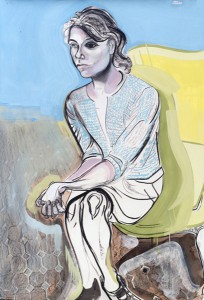
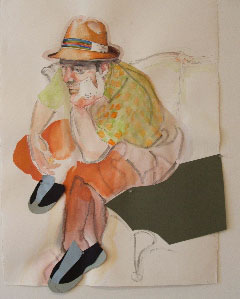
For example, “Lee with Blue Plaid” hints at the blue-collar dads many of us remember. Looking every bit the longshoreman in a blue plaid shirt, he could just as well be a steelworker of yesteryear collapsing after a difficult day. So palpable in appearance, you’ll want to give it a beer, or least bring it home and place it in front of your TV set.

This work, like all of Tomb’s pieces on display, have a casual quality, which is underscored by disjunctured linear and spatial relationships. Thus, Tomb’s work can be read either as a Warholian blankness with an emphasis on surface or as harboring the moodily passive ambiguities and dreamy distances of a Richard Diebenkorn painting.

With their skittish lines and flatly painted planes, it might appear that Tomb’s portraits would weigh heavily on the surface-and-blankness side of the scale. Such stage-set-like figures seem to argue for a view of personality as facade, and formally, to work as much against the possibility of pictorial depth as against its psychological counterpart. Yet, these portraits are fully imbued with light and space, making one wonder how much air can hang between an eye and a nose?

Kurt Shaw can be reached at kshaw@tribweb.com.

Friends on canvas

Posted on:
Buzz

“Buzz,” 44" x 30" mixed media on paper, 2001

He labels his paintings “Buzz” and “Fudge” and “Peaches.”

These aren’t still-life depictions, but David Tomb’s subjects don’t mind the names he affixes to their portraits. They’re also his friends. They drink coffee with Tomb, pronounced “Tom.” They dissect the day’s news and probe life’s meanings.

Then Tomb, a well-known San Francisco portraitist whose works are on display at the Hartnell College Visual Arts Building gallery through Dec. 20 in “the Figure Unstudied,” reaches for his brushes.

Quickly, he paints his friends.

“They must be good friends, too, because even when they see the results of my work, they come back,” Tomb said.

Fudge

“Fudge,” 44" x 30.25" mixed media on paper, 2001

“One sitting per picture. I maintain a caffeinated conversation so we’re both engaged in the process. I socialize and work at the same time.”

Tomb works in his studio, which is part of what once was a 1950s police precinct station, a building complete with holding tank, in the Mission District.

“Brick and concrete in the Dragnet modernist style,” Tomb said of the structure.

Since his friends are often restless souls and not professional artist models, Tomb limits their sitting time. Usually, it’s one three-hour session with two hours for the head and face and one for the body.

Creating quickly helps capture a spontaneity of moment and an authenticity of character, qualities of a portrait that tend to slip away with repeated sittings, he said.

The exhibition at Hartnell shows drawings, mixed-media collages and paintings.

“On the drawings, Tom works on poses lasting no longer than six or eight minutes,” said Gary Smith, gallery director.

One reason Smith brought Tomb’s works to Hartnell was to show students how a master artist uses “line and gesture to capture the essence of the human figure.”

Tomb grew up in the San Francisco Bay Area. As a boy, he became fascinated by art, which also ran in his blood.

His great-grandfather, for example, ran a booth along the Santa Cruz Boardwalk early in the 20th century. Great-grandfather sold souvenir landscapes that he painted on redwood bark.

“He was a painter and raconteur, and I still have a couple of his works,” Tomb said.

Tomb’s mother studied to be an illustrator. His brother, Bruce, is an architect who also enjoys doing art.

After a subject has stood and stretched and left his studio, Tomb may develop the portrait further. To do so, he’ll turn to notes he took during the session.

“Spidery fingers, knobby knees, double chin, major schnozz, buzz cut …”

“It’s all good,” Tomb said. “Faces and portraits. It’s what turns my motor.”

A Body of Work Inextricably Linked to the Artist’s Persona — Self Analysis

Posted on:
Whiskered Mencher

“Whiskered Mencher,” 2005, San Francisco, CA

Tomb at Buncheon: Viewers will have no trouble accepting the portraits of Bay Area painter David Tomb as drawings.

They hang unframed at Bucheon, some with collage elements that spill over a page’s rectangle, some with a second page attached to accomodate an observation or finesse a formal tight spot. Tomb does the opposite of allowing himself to “follow blindly” the images that form under his hand.

Each drawing plainly notates his view of a believably individual sitter. But representation continually competes for Tomb’s attention with his responses to what he and his materials have done. The process registers as forcefully as the subject, which may help explain Tomb’s affinity for eccentric-looking sitters.

Their cobbled-together quality gives Tomb’s portraits a credibility lacking in most contemporary hand-made images of people. They center likeness not on appearance but on fabrication and the sense of every self as an unrepeatable patchwork.

Drawings at Weiss Gallery

Posted on:
Hibernation

“Hibernation”1987 ink, charcoal, graphite 24.5" x 22" by David Tomb

The Dorothy Weiss Gallery, 256 Sutter Street, is known for showing ceramics primarily. Now Weiss has gotten interested in showing two-dimensional work, making a strong beginning with a show of drawings by David Tomb.

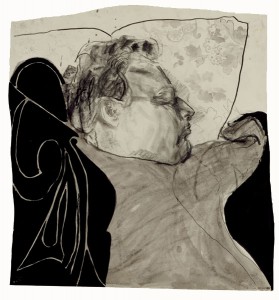
Tomb, who recently moved to New York from San Francisco, shows charcoal figure drawings in which the lines behave as if they start out being descriptive but abruptly become ends in themselves, as if Tomb’s attention kept reverting compulsively from model to marks.

Tomb intensifies into a struggle the normal draftsmanly transit of attention between subject and process, and process wins out. And that struggle, not the model, becomes the real subject of his drawings, which are getting increasingly stark.

David Tomb: Diorama

Posted on:
Steven

“Steven,” 2000, Oil on canvas, 80" x 60", by David Tomb

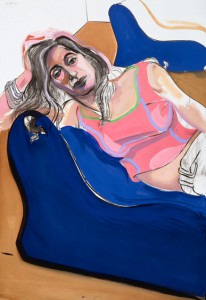
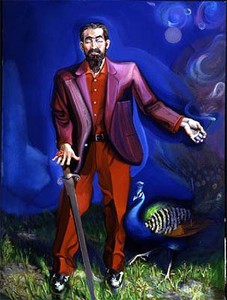
One of the Bay Area’s best painters, David Tomb defiantly traffics in an old-fangled and unhip genre: portraiture. “David Tomb: Diorama” at the Hackett-Freedman Gallery brings together four sensual, life-sized portraits of people near and dear to him. As these unfold into intimate psychological studies, Tomb emerges as a painter’s painter — that is, one who revels in the pleasures of paint itself. Masterfully blending abstract and representational elements, his rich surfaces are slathered with frostinglike furrows while the subjects’ meaty faces and flesh rise from voluptuous color shards that reflect the influences of Lucien Freud and Francis Bacon. Susan depicts a bird’s-eye view of the artist’s raven-haired wife, wearily clutching a champagne glass, against a buttery yellow backdrop. The thin-skeined Steven, an unusually impasto-leeched full-length portrait of performance artist Steven Raspa, is awash in eye-popping electric acid reds and blues. It jumps off the wall ‘atcha like a psychedelic Day-Glo dandy (replete with peacock and bubble-blower).

Portraits of Energy and Immediacy

Posted on:

David Tomb: Ogle: Portrait Drawings Hackett-Freedman Gallery San Francisco, CA

J.J.

J.J. 2003, mixed media, 44 x 30, by David Tomb

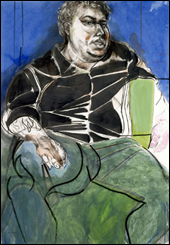
The graphic energy of David Tomb’s best portrait drawings at Hackett-Freedman blows away our expectation of psychological depth. Tomb uses his subjects’ appearance to get his hand going, not as inroads to their character. Visitors leave the show knowing no more than when they arrived about the people Tomb portrays, likenesses aside.

Collector Robert Shimshak’s face resembles Tomb’s image of it to a striking degree, yet it reads like an excuse for the lather of charcoal and gouache marks that Tomb uncorks to convey Shimshak’s legs-crossed posture and patterned shirt.

Tomb’s portraits seem up-to-the-minute not because they show a knowledge of modern portraitists such as Oskar Kokoschka and Alice Neel, though they do, but because Tomb looks harder at, and believes more in, the way fabric creases report the clothed body than at the way faces clothe identity.

Notice how a few deft brush strokes of black over white render the folds in the black shirt of “J.J.” (2003). They report a fleshy torso to match the subject’s face, but also evoke a sort of cladding, like an armadillo shell, suggestive of some unobvious hardness.

Feeling Groovy

Feeling Groovy, 2003, charcoal & gouache, 44 x 30, by David Tomb

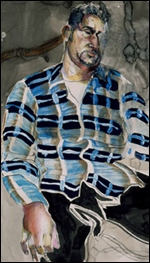
In “Feeling Groovy” (2003) — the most impressive thing here — the technique that describes the spaced-out, unnamed sitter conveys his relaxation more immediately than his slouching pose.

In his treatment of the man’s plaid shirt, Tomb flutters a little manifesto celebrating the athletics of hand and eye, as against the supposed intellectual rigor for which the modernist grid stands.

The exhibited portraits’ unevenness can make a viewer wonder whether Tomb yet inhabits comfortably the uncompromising artistic posture he has earned.

No matter, he has let his hand go and it will take him there.